
Web Development • 9 MIN READ
Why your website looks fine but isn't converting
Traffic without leads is a conversion problem, not a traffic problem. Here's how to diagnose what's really blocking enquiries.
Practical guides on Zoho CRM, websites and growth for Australian businesses, written by the Vixo team in Forestville, NSW. See related services →
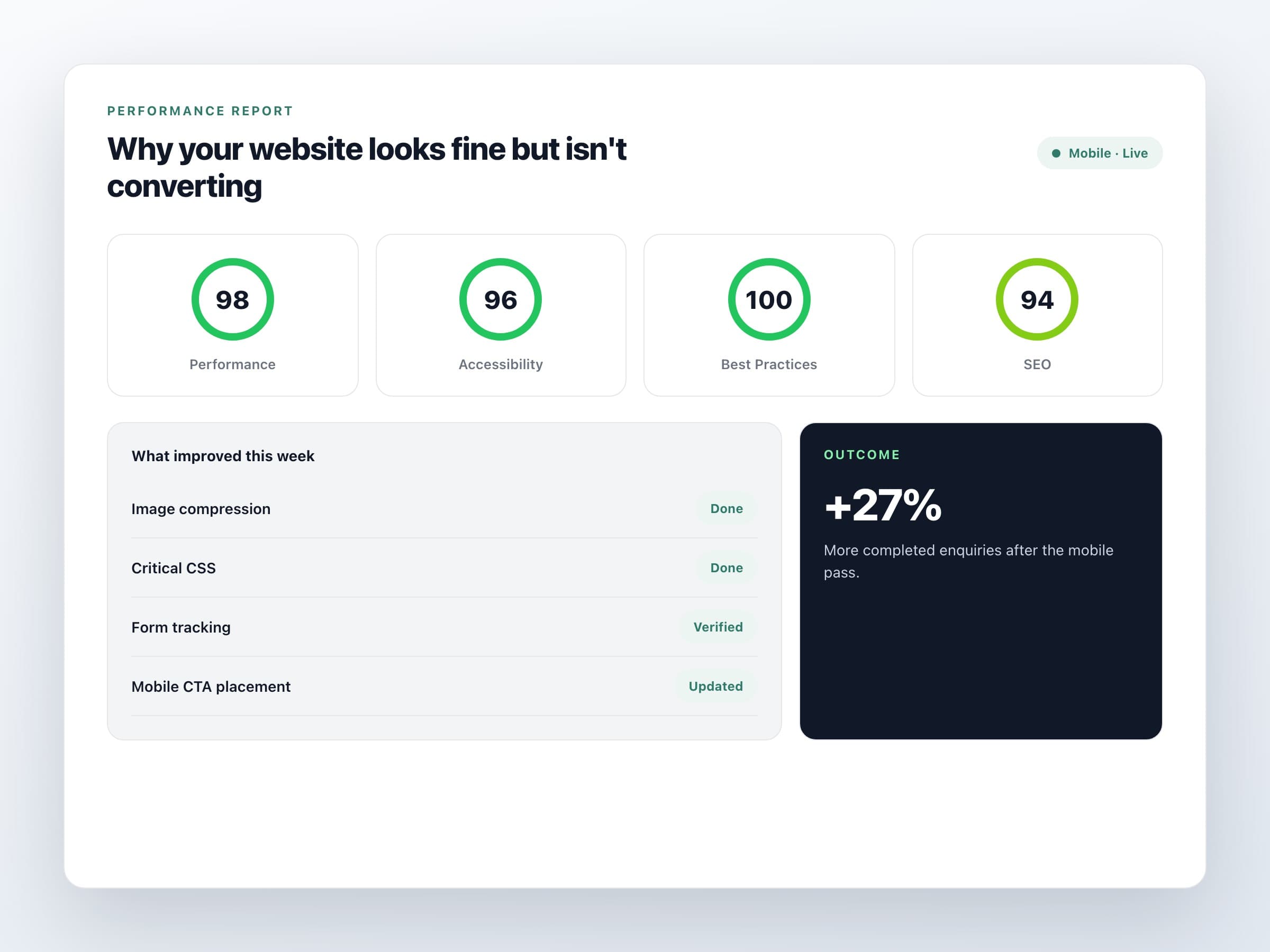
Why web development matters now
If your website gets steady traffic but the phone stays quiet, you're not alone. Plenty of Australian businesses sit in this awkward middle ground: the site looks polished, analytics show visitors, and yet enquiries are flat. At that point it's tempting to blame the market, the ads or 'people just browsing'. More often, the site is failing a quieter test, turning interest into action.
A low website conversion rate rarely means everything is broken. It usually means one or two friction points are doing most of the damage. Visitors arrive with intent, hit hesitation, and leave. That hesitation might be a slow mobile load, a buried phone number, a vague headline, a form that asks for too much, or a page that never answers the one question they came with: 'Is this the right business for me?'
Key web development takeaways
Clearer visibility across teams
Start by separating vanity metrics from useful ones.
Less manual admin every week
Sessions and bounce rate are clues, not the verdict.
Better decisions from real data
Look at enquiry rate (form submits, calls, chats) against traffic by device and channel.
Faster follow-through on priorities
Mobile often accounts for most visits and converts worse than desktop.
Fewer dropped handoffs
If paid traffic converts poorly while organic is healthier, the landing experience may not match the ad promise.
Traffic without leads is a conversion problem, not a traffic problem. Here's how to diagnose what's really blocking enquiries.
A practical way to move forward
Message clarity matters as much as design. Business owners often write for themselves: service lists, jargon, soft claims. Prospects need a clear outcome, proof they can trust you, and a simple way to start. Add specific proof near the call to action, suburbs served, response times, short testimonials, before/after examples. Reduce form fields to what you need for a first conversation. Put the primary contact option where thumbs naturally land.
Action points
Start here
Technical foundations still count.
Tighten the process
Compress images, cut heavy scripts, host close to your audience and fix broken tracking so you can measure what you change.
Measure the outcome
Then improve one conversion path at a time: homepage to contact, service page to call, campaign landing page to form.
Expand carefully
Re-check results after two weeks.
